

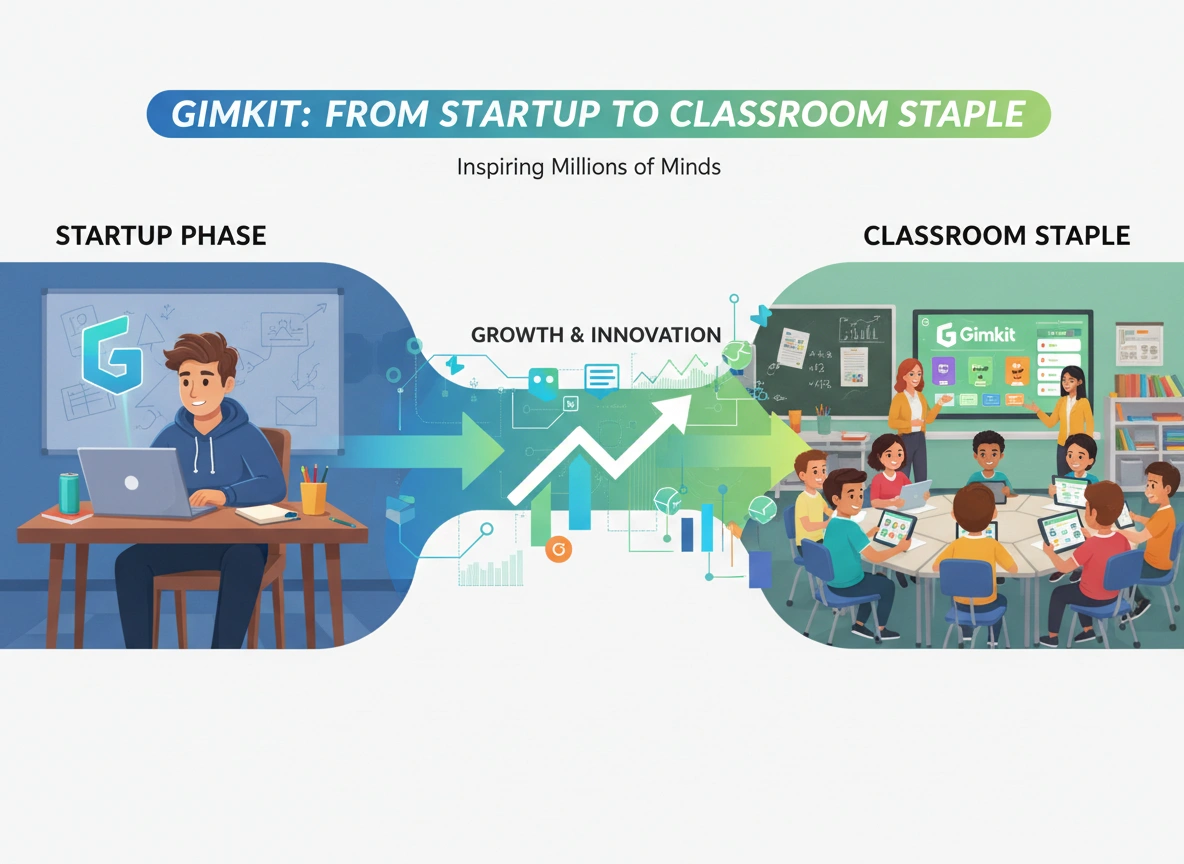
In the crowded landscape of educational technology, few stories are as compelling as that of Gimkit. While giants like Kahoot! and Quizizz have long dominated the gamified learning space, Gimkit emerged not from a corporate boardroom or a Silicon Valley incubator, but from a high school student’s frustration. What began as a personal project has rapidly transformed into a classroom staple, reshaping how students engage with assessments and how teachers facilitate learning. This article explores the origins, development, challenges, and lasting impact of Gimkit, analyzing how it evolved from a simple startup idea into a powerhouse of modern education.
The Origins: A Student-Centric Inception
The story of Gimkit begins in 2017 with Josh Feinsilber, a high school student in Seattle, Washington. Unlike many EdTech founders who approach the market with a solution looking for a problem, Feinsilber was living the problem daily. He sat in classrooms where review games were common, but he noticed a critical flaw in the existing options: engagement was often superficial. Students played for points, but once they fell behind on the leaderboard, their motivation evaporated.
Drawing inspiration from his own experiences and frustrations, Feinsilber set out to build something different. He wanted a game that wasn’t just about answering questions correctly but involved strategy, risk, and reward—elements common in video games but absent in most educational tools. This led to the creation of “Gimkit,” a name derived from “Game Kit.”
The core differentiator was immediately apparent. Unlike traditional quiz platforms where points are static, Gimkit introduced an in-game economy. Students earned virtual currency for correct answers, which they could then reinvest into upgrades, power-ups, or insurance against wrong answers. This mechanic kept students engaged even if they started slowly, as strategic investment could lead to exponential growth, allowing anyone to win until the very last second.
The Development Journey: Iteration and Community Growth
Gimkit’s initial release was humble. It was a web-based application with a simple interface, launched while Feinsilber was still juggling homework and exams. However, the grassroots nature of its development became its greatest strength. Because the creator was a student, the user interface (UI) and user experience (UX) were intuitively designed for students. It felt less like a test and more like a mobile game.
Early adoption was driven by word-of-mouth. Teachers who stumbled upon the platform were struck by the intense focus it generated in their classrooms. Students weren’t just clicking answers; they were calculating risks and managing resources. This buzz led to Gimkit’s first major milestone: its acceptance into a startup accelerator. This provided not only funding but mentorship that helped structure the business side of the project.
A pivotal moment in Gimkit’s development was the decision to embrace a subscription model early on, while keeping a generous free tier. This sustainable approach allowed the small team—often just Feinsilber and later joined by Jeff Osborn—to focus on product quality rather than chasing venture capital metrics or selling user data. This commitment to privacy and sustainability resonated deeply with educators, who are increasingly wary of how student data is handled.
Over the years, the platform expanded beyond the classic mode. The team introduced various game modes like “Trust No One” (inspired by the social deduction game Among Us), “The Floor is Lava,” and collaborative modes where the entire class works toward a shared goal. These updates weren’t random; they were direct responses to the changing trends in youth culture, ensuring the platform remained culturally relevant to students.
Challenges Along the Way
The path from a high school project to a global business was not without obstacles. One of the most significant challenges Gimkit faced was scaling its infrastructure. As the user base grew from hundreds to millions, particularly during the remote learning boom of the COVID-19 pandemic, server stability became a critical issue. The small team had to rapidly learn enterprise-level DevOps to ensure that a classroom of 30 students wouldn’t experience lag during a high-stakes review session.
Another challenge was content moderation and academic integrity. As with any platform allowing user-generated content, Gimkit had to implement systems to prevent inappropriate material while maintaining the ease of creating quizzes (often called “Kits”). Furthermore, the competitive nature of the game sometimes led to friction in the classroom. The team responded by developing more collaborative modes, shifting the focus from individual dominance to teamwork, which helped broaden the tool’s appeal to teachers prioritizing social-emotional learning (SEL).
Perhaps the most persistent challenge was differentiating itself in a saturated market. With titans like Kahoot! holding massive market share, Gimkit had to constantly prove why it was worth the switch. They did this by doubling down on “replay value.” While a standard quiz gets boring after one or two plays, Gimkit’s dynamic economy meant the same set of questions could be played dozens of times with different outcomes, maximizing the utility of the teacher’s preparation time.
Impact on Education: Beyond the Leaderboard
Gimkit’s impact on education goes beyond making quizzes fun; it has fundamentally altered the feedback loop in classrooms. In a traditional assessment, a student answers a question, waits for grading, and receives feedback days later. In Gimkit, the feedback is immediate. If a student loses money due to a wrong answer, the sting is instant but low-stakes, encouraging them to learn the correct answer immediately so they can recover their losses.
Teachers report that this “high-repetition, low-stakes” environment is ideal for mastery learning. Students willingly answer the same question 20 times in a 10-minute session because they need the currency it provides. This repetition helps cement facts and concepts into long-term memory more effectively than traditional rote memorization.
Furthermore, the strategic element introduces critical thinking and financial literacy concepts into unrelated subjects. A history student playing Gimkit isn’t just recalling dates; they are deciding whether to purchase a “streak bonus” or a “multiplier.” They are analyzing the return on investment (ROI) in real-time. This hidden curriculum—teaching resource management alongside the core subject—is a unique benefit that sets Gimkit apart.
The platform has also become a vital tool for accessibility and inclusivity. The “text-to-speech” integration and the ability for students to play at their own pace (rather than a timer on a central screen) reduce anxiety for students who process information differently. It levels the playing field, allowing distinct learning styles to flourish in the same environment.
Becoming a Classroom Staple
Today, Gimkit is no longer an experimental alternative; it is a staple. It is frequently listed alongside Google Classroom and Canvas as essential tech in schools across North America and beyond. Its transition to “staple status” can be attributed to three key factors: reliability, responsiveness, and community.
Reliability: Teachers know it works. The platform is stable, works on almost any device with a browser, and requires zero setup for students beyond a game code. In the high-pressure environment of a 45-minute class period, this reliability is priceless.
Responsiveness: The Gimkit team maintains a highly active presence on social media, often engaging directly with teachers. Feature requests are frequently implemented, and bugs are squashed quickly. This transparency builds trust. When teachers feel heard, they become evangelists for the product.
Community: A vibrant community of educators shares “Kits” covering every conceivable subject. A teacher needing a review on cellular biology or irregular French verbs can find a pre-made, high-quality Kit in seconds. This crowdsourced library reduces workload and lowers the barrier to entry for new users.
Future Potential and Conclusion
Looking ahead, Gimkit shows no signs of slowing down. The recent introduction of “Gimkit Creative,” which allows students and teachers to design their own game maps and mechanics, signals a shift toward a metaverse-like educational environment. This moves the platform from a consumption model (playing games) to a creation model (building games), aligning with the highest levels of Bloom’s Taxonomy.
The evolution of Gimkit from a high schooler’s side project to a cornerstone of modern EdTech is a testament to the power of user-centric design. By focusing relentlessly on the student experience—making learning genuinely addictive through game theory—Josh Feinsilber and his team have cracked the code of engagement.
As education continues to hybridize and evolve, tools that prioritize active participation over passive consumption will lead the way. Gimkit has proven that assessment doesn’t have to be a source of anxiety; it can be a source of joy, strategy, and connection. For the millions of students who now groan when the bell rings because they want “just one more round,” Gimkit has already won the most important game of all: making learning something they want to do, not something they have to do.
Please visit website for more info.
