

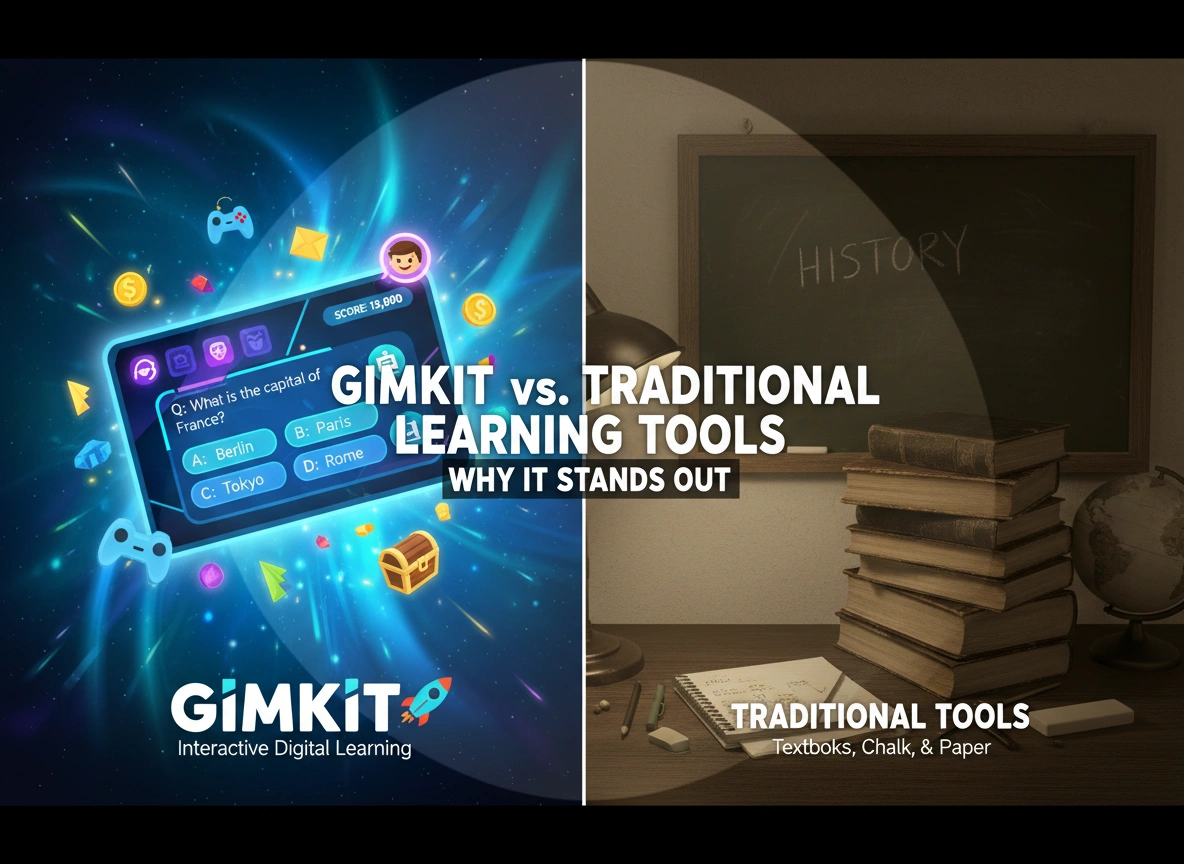
Walk into a standard classroom during a review session, and you might see students slumped over worksheets or half-heartedly raising hands to answer flashcard questions. Now, walk into a classroom using Gimkit. The energy shifts immediately. Students are leaning forward, strategizing with peers, and groaning or cheering as they earn in-game currency. This isn’t just playing; it’s active learning.
For decades, traditional learning tools—textbooks, worksheets, static flashcards, and basic multiple-choice quizzes—have been the backbone of education. While they serve a purpose, they often struggle to maintain the one currency every teacher fights for: attention. Gimkit, a live learning game show platform, disrupts this model by blending high-stakes gamification with rigorous academic practice. It doesn’t just ask students to answer questions; it asks them to manage resources, collaborate, and think critically.
This article explores how Gimkit compares to traditional tools, examining why its unique approach to engagement, adaptability, and data tracking makes it a standout choice for modern educators.
The Engagement Gap: Passive vs. Active Participation
The most glaring difference between Gimkit and traditional tools lies in student engagement. Traditional methods often rely on passive consumption or rote memorization. A worksheet asks a student to recall information, but it rarely provides an immediate incentive to do so. The reward is often delayed—a grade received days later.
The Mechanics of Motivation
Gimkit changes the reward structure entirely. It utilizes a “participatory economy.” When students answer questions correctly, they earn virtual cash. They can use this cash to buy upgrades (like earning more money per question) or power-ups (to protect themselves or hinder opponents).
This system taps into extrinsic motivation to fuel intrinsic learning. A student who might not care about the definition of “mitochondria” suddenly cares deeply because knowing it allows them to buy a multiplier upgrade. Traditional flashcards cannot replicate this dynamic. With flashcards, the only feedback is “correct” or “incorrect.” In Gimkit, the feedback is progress within a dynamic ecosystem.
Scenario: Consider a math review on multiplication tables.
- Traditional Tool: A timed paper quiz. Students feel anxiety about the clock and fear of failure.
- Gimkit: A game mode like “The Floor is Lava.” Students answer questions to keep their team above rising lava. The anxiety transforms into excitement and teamwork. They answer more questions in 15 minutes of gameplay than they would in an hour of worksheet time.
Repetition Without Boredom
One of the fundamental principles of learning is spaced repetition. To move knowledge from short-term to long-term memory, students must encounter information multiple times. Traditional tools struggle here. Doing the same worksheet twice is tedious. Reviewing the same flashcards becomes monotonous.
Gimkit solves the “boredom factor” of repetition. Because the game mechanics change even if the questions remain the same, students are willing to answer the same set of questions dozens of times.
Diverse Game Modes
Unlike Kahoot! or Quizizz, which generally follow a linear quiz format, Gimkit offers varied game modes that change the strategy, not the content.
- Trust No One: A social deduction game similar to Among Us, where students answer questions to conduct investigations and find the impostor.
- Tag: Teams compete to “tag” each other by answering questions to earn energy.
- Infinity Mode: A collaborative challenge where the whole class works together to collect “Infinity Stones.”
In a traditional setting, asking a student to review a history chapter five times would result in diminishing returns and disengagement. With Gimkit, a teacher can use the same question set across five different game modes over a week. The students perceive it as five different experiences, but the academic reinforcement remains constant.
Adaptability and Differentiation
A significant limitation of traditional tools like textbooks or standardized worksheets is their “one-size-fits-all” nature. If a worksheet is too hard, a student gives up. If it’s too easy, they check out. Differentiation usually requires the teacher to create three different versions of the same assignment—a massive time sink.
Gimkit offers built-in adaptability that traditional tools lack.
Self-Paced Progression
In a standard lecture or a tool where the teacher advances the slides, the fastest student waits while the slowest student panics. Gimkit is entirely self-paced on the student’s device. They answer questions at their own speed. If they get a question wrong, the system ensures they see it again later, enforcing mastery learning.
Instant Feedback Loops
Traditional homework often creates a “learning lag.” A student might practice a math method incorrectly for 20 problems, only to find out the next day they did it wrong. This reinforces bad habits.
Gimkit provides immediate correction. When a student answers incorrectly, the correct answer is displayed instantly. Furthermore, because they want to earn money efficiently, they are incentivized to read the correct answer so they don’t miss it next time. This micro-correction loop happens dozens of times in a single session, far outpacing the feedback speed of a graded paper.
Teacher Usability and Data Analytics
For any tool to be effective, it must be usable for the instructor. Traditional grading is the bane of the teaching profession. It is time-consuming, prone to subjectivity, and often happens too late to adjust instruction effectively.
Grading vs. Analyzing
Gimkit automates the grading process, but it goes further by providing actionable analytics. After a game, a teacher receives a detailed report showing:
- Overall class accuracy.
- Individual student performance.
- A breakdown of each question.
If a teacher sees that 90% of the class missed Question #4, they know immediately that they need to reteach that specific concept. With a stack of worksheets, realizing a trend requires manually tallying errors across 30 papers. Gimkit creates a “KitCollab” mode where students can even help create the questions, turning the assessment creation process into a learning activity itself.
Integration with Existing Workflows
While traditional tools are often standalone (a book is just a book), Gimkit integrates with the digital ecosystem schools already use. It allows teachers to import question sets from Quizlet or spreadsheets, saving hours of typing. It creates a bridge between the static content teachers already have and the dynamic engagement students crave.
Financial Literacy and Soft Skills
Perhaps the most surprising advantage of Gimkit over traditional tools is the incidental learning of soft skills. Because the core mechanic involves a virtual economy, students are inadvertently practicing financial literacy and strategic planning.
When playing, students must decide: Do I save my money for a big upgrade later, or buy a small one now? Do I invest in insurance in case I get a question wrong?
This introduces risk assessment and resource management into subjects that have nothing to do with economics. A Spanish vocabulary review becomes a lesson in strategy. Traditional tools rarely facilitate cross-disciplinary skill building in this way. A fill-in-the-blank history quiz assesses history knowledge and nothing else. Gimkit assesses history knowledge while exercising critical thinking and strategic foresight.
Community and Collaboration
Finally, traditional assessment is often an isolating experience. “Keep your eyes on your own paper” is the mantra. While independent work is necessary, it doesn’t prepare students for a collaborative workforce.
Gimkit fosters community. Many game modes are team-based, requiring students to communicate and coordinate. In “Snowbrawl,” teammates must decide who is gathering snowballs (answering questions) and who is throwing them. They must shout out warnings and encourage one another.
This creates a positive classroom culture where high-achieving students help struggling students because the team’s success depends on everyone contributing. The “smart kid” isn’t just finishing first and sitting quietly; they are actively mentoring peers to boost the team score. Traditional tools rarely offer a framework for this type of structured, academic peer interaction.
Conclusion
Traditional learning tools will always have a place in education. There is value in the quiet focus of a book or the tactile nature of writing by hand. However, when it comes to review, reinforcement, and engagement, Gimkit stands in a league of its own.
By transforming assessment into an immersive experience, Gimkit addresses the core challenges of modern teaching: keeping students interested, accommodating different learning speeds, and providing instant, actionable feedback. It turns the passive act of recall into an active strategy of resource management and collaboration. For educators looking to bridge the gap between rigorous standards and student enthusiasm, Gimkit is not just a game—it is a powerful pedagogical upgrade.
